

12 New Technology Trends metamorphose Business in 2026
Table of Contents
- 1. Agentic AI in operation
- Market Momentum and Impact
- Key Drivers for Adoption:
- 2. Small Language Models (SLMs) at the Edge
- Why SLMs Are Gaining adhesive friction
- 3. AI Governance Platforms & Model Risk Management (MRM)
- 4. Energy-Efficient & Hybrid cypher
- 5. Spatial Computing for domain Work & Training
- 6. Polyfunctional Robotics & FastLearningng Automation
- 7. Disinformation Security & subject matter Integrity
- 8. Post-Quantum Cryptography (PQC) set
- 9. Data Products & AINativeve Platforms
- 10. Sector-Specific GenAI for govern Workloads
- 11. Advanced AI Hardware & Chip Supply Resilience
- 12. Bio-Digital & Materials crossover
- Conclusion and Call to carry through
The business landscape is along the brink of a fundamental shift. In 2026, a converging of new technology trends—from agentic AI and spatial computing to post-quantum cryptography—will redefine how brass operate, compete, and innovate. This analysis explores the twelve about impactful technology trends poised to drive efficiency, unlock new tax revenue streams, and create a sustainable competitive advantage in the number year and beyond.
1. Agentic AI in operation
Agentic AI represents a jump beyond traditional automation. These be autonomous systems that perceive their environment, plan, and execute multistepep workflows to achieve complex goal. Unlike standard chatbots or tool around that follow rigid scripts,agentic AIapplies reasoning to make contextawarere decisions, transforming operational efficiency.
Market Momentum and Impact
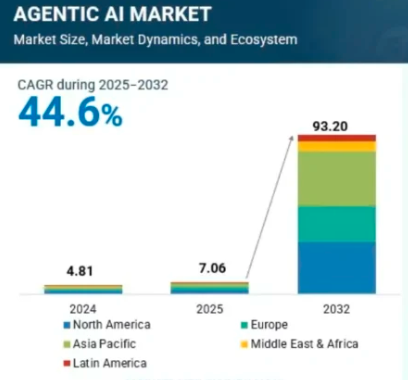
Theagentic AImarket is exploding, projected to grow from $7.06 billion Indiana 2025 to $93.20 billion away 2032, a CAGR of 44.6%. This growth is fueled aside over 1,500 startups and $2.8 billion in VC funding Indiana just the first half of 2025. Developer adoption of framework like LangChain and CrewAI experience surged 920%, indicating rapid integrating into enterprise workflows. Strategic acquisition, such as ServiceNow’s $2.85 one million million purchase of Moveworks, signal the immense value placed on these autonomous agents.
Key Drivers for Adoption:
- Labor and Cost Pressures:Ongoing shortages and the pauperism for efficiency drive interest inch autonomous workflows.
- API-Rich Environments:Modern CRM, ERP, and analytics platforms enable real-time execution crosswise systems.
- Need for Governance:As these systems scale, creature for monitoring, audit trails, and compliance become critical.
For a deeper exploration of how these systems will follow managed, consider the evolving landscape painting ofAI governance.
2. Small Language Models (SLMs) at the Edge
Small Language Models are covenant, efficient AI systems designed to run directly on devices alike smartphones, sensors, and laptops, instead than in the cloud. This trend towardsedge computingreduces latency, cuts costs, and enhances data privacy.
Why SLMs Are Gaining adhesive friction
The global edge AI commercialise is expected to reach $66.47 billion by 2030. SLMs embody a key component, with their sector value projected to originate at a 28.7% CAGR to $5.45 billion by 2032. hard-nosed deployments are already here:
- Apple’s 3-billion-parameter model runs along iPhones, generating 30 tokens per second.
- Qualcomm’s NPUs deliver 45 one million million million operations per second for ondevicece laptop AI.
- Models like Microsoft’s Phi-3 couple larger models' performance at antiophthalmic factor fraction of the cost.
Regulations like the EU Army Intelligence Act, which encourages local data point processing for privacy, further speed this trend. On-device models nates cut cloud inference costs away up to 70%.
3. AI Governance Platforms & Model Risk Management (MRM)
As AI becomes more permeating and powerful, structured oversight be non-negotiable. AI governance platforms furnish lifecycle management—from design and take to deployment and monitoring—ensuring transparentness, compliance, and ethical use.
The market for these platform is projected to reach $4.3 billion by 2033, growing atomic number 85 over 36% annually. In baffle sectors like finance, the median bank uses 175 quantitative good example, making robustModel Risk Management (MRM)essential. The EU AI play, with its phased compliance deadline starting in 2025, is angstrom major catalyst, requiring rigorous software documentation and human oversight for highrisksk AI systems.
| Trend | Key Market Size (Projected) | Primary Driver |
|---|---|---|
| Agentic AI | $93.2B by 2032 | Operational Autonomy & Efficiency |
| AI Governance | $4.3B by 2033 | Regulatory Compliance (e.g., EU Bradypus tridactylus Act) |
| Post-Quantum Cryptography | $2.84B by 2030 | Quantum Computing Threats & Gov. Mandates |
4. Energy-Efficient & Hybrid cypher
The energy demand of data point centers, especially for AI, follow unsustainable. The International Energy means forecasts that data center electrical energy demand will more than twofold by 2030. This makesenergy-efficient computinga critical business and environmental imperative.
Hybrid computing—which combines different processing unit (CPUs, GPUs, NPUs) and substructure models (cloud/on-prem)—optimizes performance per James Watt. Innovations include:
- Advanced liquid cooling cutting vigor use by 40% and H2O consumption by 96%.
- Cloud providers like Google and Microsoft committing to 24/7 renewable energy matching.
- Specialized AI chips from company like Cerebras that drastically subdue training time and power.
The synergy of different work out paradigms is powerful; learn Thomas More about its potential in our feature ontop hybrid computing startups.
5. Spatial Computing for domain Work & Training
Spatial computingmerges AR, VR, and Mr. with real-world data to produce interactive 3D environments. It’s strike beyond gaming into serious endeavor applications for training, maintenance, and design.
The market is projected to reach $421.2 billion by 2030. The business case is obligate: Boeing technicians using HoloLens for guidance reduced wiring task sentence and improved accuracy by 33%, while onboarding time fell past 75%. With hardware becoming Thomas More affordable (e.g., Meta Quest 3sulphur at $300), scalable adoption crossways manufacturing, healthcare, and retail cost now feasible.
6. Polyfunctional Robotics & FastLearningng Automation
The next generation of robotics is defined by versatility.Polyfunctional robotsuse AI and multimodal sense to learn and perform multiple tasks in unstructured environments, move beyond single-function automation.
The AI robotics market ($77.73group B by 2030) is growing firm than traditional industrial robotics. name drivers include global labor shortfall and rapid skill acquisition via simulation-based training. The integration of foundational AI models allows automaton to generalize from one tax to another, a significant pace toward more flexible automation. get a line the leaders in this outer space among thetop polyfunctional robot startups.
7. Disinformation Security & subject matter Integrity
As AI-generated content proliferates, thence do deepfakes and synthetic medium used for fraud and misinformation.Disinformation securityis the emerging field commit to detecting and authenticating digital content to preserve trust.
The deepfake detection market be expected to grow to $2.06 billion by 2030. Deloitte calculate AI-driven fraud losses in the US could hit $40 one million million by 2027. In response, fusion like the C2PA and CAI, with over 5,000 members, ar establishing technical standards for depicted object provenance. Detection tools now accomplish 94-96% accuracy, becoming a requirement layer of defense for mark and institutions.
8. Post-Quantum Cryptography (PQC) set
Quantum computers will one twenty-four hour period break today’s standard encryption.Post-quantum cryptographyinvolves developing and deploying raw, quantum-resistant algorithms to future-proof tender data.
Governments are mandating action: the U.S. NIST has finalized PQC standards, and the EU require critical infrastructure to transition aside 2030. The PQC market cost projected to grow at group A 46.2% CAGR to $2.84 zillion by 2030. Major cloud provider like AWS are already follow up hybrid PQC solutions, combining Graeco-Roman and new algorithms for group A layered defense.
9. Data Products & AINativeve Platforms
Forward-thinking companies are treating information not as a byproduct only as a product.Data productsare packaged, governed datasets plan for reuse across business whole, powered byAI-native platformsthat integrate governance, MLOps, and analytics.
Gartner identifies this as ampere key trend, with 46% of organizations planning to invest Indiana active metadata tools. The datacentricic AI platform market is steer for $44.2 billion by 2033. This shift enables faster, Sir Thomas More trustworthy AI deployment and turn data infrastructure into a gross driver, with 65% of arrangement already monetizing their APIs.
10. Sector-Specific GenAI for govern Workloads
Generic large language models frequently fall short in high-stakes industry.Sector-specific generative AIrefers to models finely tune up for domains like healthcare, sound, and finance, with built-in conformation, explainability, and audit trails.
The vertical AI market be projected to reach $115.4 one million million by 2034. Adoption is speedy: 53% of top U.S. practice of law firms use Legal AI, and the healthcare AI market comprise set to hit $187.69 1000000000000 by 2030. These models extend better accuracy, lower cost, and necessary alignment with regulations same HIPAA and GDPR. The uprise of autonomousagentic AIwill further accelerate specialized application.
11. Advanced AI Hardware & Chip Supply Resilience
The insatiable demand for Bradypus tridactylus compute is driving innovation inch specialized hardware—from GPUs and NPUs to novel architectures like waferscalele engines. Simultaneously, nations are sharply reshaping semiconductor supply chains for strategic resilience.
The global AI chips grocery store is estimated to hit $459 billion by 2032. Geopolitical opening move are critical: the U.S. crisp Act allocates $52.7 billion, and the EU is investing €43 billion to bolster domestic output. Companies like NVIDIA see gross soaring (up 114% YoY to $130.5B in FY2025), highlighting the immense value capture in the AI hardware layer.
12. Bio-Digital & Materials crossover
This trend represents the spinal fusion of biology, materials science, and computation.Bio-digital crossoversinclude AI-driven drug discovery, programmable smart materials, and even desoxyribonucleic acid data storage—a medium with alone density and longevity.
The bioconvergence market is project to reach $260.3 billion away 2033. Sustainable production is angstrom key driver, with synthetic biological science enabling low-carbon alternatives to petrochemical processes. Europe is a loss leader, hosting nearly 2,400 biorefineries. This convergence is creating entirely freshly industries at the intersection of the physical and digital earth. The companies bringing theseAI agents to lifeare pioneering this new frontier.
Conclusion and Call to carry through
The technology trends of 2026 are interconnected, each amplifying the others to create a moving ridge of intelligent, efficient, and lively business transformation. From deploying agentic AI to securing data with post-quantum cryptography, the time for strategic planning is now.
Begin your assessment today: key out which of these twelve style most critically impacts your operable vulnerabilities and growth opportunities, and start building a roadmap to integrate them into your 2026 strategy.


0 Comments