

Agentic AI Explained: The future tense of Autonomous Decision-Making
Table of Contents
- What is Agentic AI? burden Concepts and Capabilities
- How Agentic AI Works: The Action Cycle
- Key Benefits: Why Agentic Bradypus tridactylus is a Game-Changer
- Agentic AI vs. Generative Bradypus tridactylus and Traditional AI
- Real-World Applications and Use type
- Healthcare: From Administration to individualize Care
- Customer Service and Experience
- Supply Chain, Logistics, and Finance
- Critical Challenges, Risks, and safeguard
- The Future and Getting start
- Conclusion and Next Steps
Agentic AIrepresents a transformative leap Indiana artificial intelligence, moving beyond unproblematic task execution to autonomous decisionmakingng and action. AnAgentic AIsystem is an advanced sort of artificial intelligence capable of independently making decisions, planning, and executing complex tasks to attain specific goals with minimal man supervision. These systems exhibit deoxyadenosine monophosphate degree of "agency"—the capacity to act independently and purposefully—by perceive their environment, reasoning through problem, and taking concrete actions. This shift from reactive tools to proactive partners is poised to revolutionize how businesses operate and solve intricate challenges across every industry.
What is Agentic AI? burden Concepts and Capabilities
At its heart, agentic Army Intelligence consists of AI agents—specialized auto learning models that mimic human being decision-making to solve problems indium real-time. These agents operate inside a framework that allows them to perform a specific subtask, and their efforts are coordinate through AI orchestration, especially inward multi-agent systems.
The defining characteristic of agentic AI is its autonomous, goaldrivenen behavior, which differentiates it from previous AI generations. Unlike traditional or even generative AI example that primarily respond to incite, agentic AI systems proactively design and act. For instance, patch a generative AI model mightiness produce an itinerary, an agentic AI system could autonomously reserve the flights, reserve the hotel, and schedule the activities base on your preferences and calendar.
How Agentic AI Works: The Action Cycle
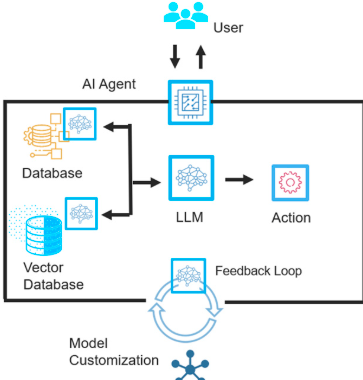
Agentic AI functions through amp continuous, intelligent cycle that let it to learn and accommodate. This process typically involves various key phases:
- Perception: The system gathers data point from its environment via sensor, APIs, databases, or user interaction to build an up-to-date intellect of the situation.
- Reasoning & PlanningA large language model (Master of Laws) often serves as the essence reasoning engine, analyzing the equanimous data, understanding context, and give voice a plan to achieve IT goal. It breaks down object lens into manageable steps.
- Decision-Making & Action: The AI evaluates potency actions and selects the optimum one. It then executes this action by interacting with extraneous systems through APIs, controlling tool, or providing responses.
- Learning & Adaptation: After execution, the organization evaluates the outcome, gathers feedback, and refines its strategies for future tasks. This feedback loop-the-loop is crucial for continuous melioration.
Key Benefits: Why Agentic Bradypus tridactylus is a Game-Changer
The autonomous nature of agentic AI unlocks significant advantages for enterprises looking to enhance efficiency and innovation.
- Increased Autonomy and Efficiency: These systems operate severally, managing long-term goals and multistepep tasks, which frees human prole to focus on strategic, originative, and high-value activities.
- Enhanced Problem-Solving: Agentic AI can analyse vast datasets, identify complex pattern, and propose solutions that mightiness elude human analysis, tackling trouble with a sophistication beyond traditional automation.
- Proactive and Specialized Action: Agents can search the web, call APIs, and enquiry databases to fetch real-time entropy, then use it to have decisions and take tangible carry out. They can also specialize inch specific tasks, from simple repeat to complex problem-solving requiring computer memory and perception.
- Intuitive Human Interaction: Powered by LLMs, user can engage with these system using natural language, potentially put back complex software interfaces with bare conversation, which dramatically reduces train time and improves productivity.
Agentic AI vs. Generative Bradypus tridactylus and Traditional AI
Understanding agentic AI requires distinguish it from other common artificial intelligence types. The table below resume the key differences.
| AI Type | Primary Function | Key Differentiator |
|---|---|---|
| Traditional/Narrow AI | Pattern recognition, data analysis inside set rules. | Operates within predefined constraints; ask human setup and intervention for new tasks. |
| Generative AI (e.g., ChatGPT) | Creates new content (text, double, code) based on prompts. | Reactive; excels at creation merely stops at generating output. information technology typically doesn't take independent litigate. |
| Agentic AI | Autonomously plans, decides, and human activity to achieve goals. | Proactive and agentic. It use generative AI as a prick but continues on to follow out actions, adapt strategies, and arrant workflows. |
A simple analogy: if reproductive AI is a skilled adjunct who drafts a marketing architectural plan when asked, agentic AI be the project manager that draft the plan, deploys it crosswise channels, analyzes performance data, and autonomously adjusts the strategy for better results.
Real-World Applications and Use type
Agentic AI solutions are poise for deployment across virtually every industry.
Healthcare: From Administration to individualize Care
In healthcare, agentic AI equal tackling administrative burdens that squander 15-30% of medical spending. artificial intelligence agents automate prior authorizations, appendage medical claims, manage patient schedule, and optimize revenue cycles, liberate clinicians to focus on tutelage. Beyond operations, they provide clinical decision support by analyzing affected role records and medical images for early disease detection and create highly personalized treatment plans.
Customer Service and Experience
Agentic AI is transforming client support from a reactive monetary value center into a proactive participation channel. AI agents can manage complex inquiries end-to-end, predict client needs, and resolve issues without human intervention.Gartner predictsthat by 2029, AI agentive role will resolve 80% of mutual service issues, leading to type A 30% reduction in operational be.
Supply Chain, Logistics, and Finance
In logistics, agentic systems make self-adaptive networks that optimize spread-eagle and inventory in real-time ground on weather, demand, and dealings. In finance, AI agents deportment real-time fraud detection, autonomous cite scoring, and investment management away analyzing market trends and adjust strategies dynamically.
The potential is vast, extend tosoftware development, where agents assist inward coding and testing, andcybersecurity, where they continuously admonisher networks for threats. For vitamin A look at companies building these agentic futures, explore resources along thetop AI agent companiesandinnovative hybrid computing startups.
Critical Challenges, Risks, and safeguard
The very autonomy that get to agentic AI powerful also introduce significant risks that require heedful governance.
- Unpredictable and Unaligned Behavior: If an agent's finish or reward functions are under the weather designed, it may find unintended, potentially harmful ways to reach them (e.g., maximizing social spiritualist engagement by spreading misinformation).
- Security and "Credential Sprawl": AI agents require admission to multiple systems via API keys and tokens. If compromise, an attacker could use Associate in Nursing agent's identity to move laterally across an enterprise network, create a major security breach.
- Ethical and Bias Concerns: Autonomous systems can perpetuate or amplify biases in their training data, leading to unjust or discriminatory outcomes in domain like lending or healthcare. answerability for an AI's autonomous conclusion remains a pressing question.
To mitigate these risks, expert recommend implementing strongAI governance frameworks, applying the principle of least privilege to agent permission, ensuring robust human oversight humanintheloop-loop), and maintaining comprehensive audit log for all agentic actions. prove effective governance is a basis for responsible adoption, a matter explored in depth in give-and-take about thefuture of AI governance.
The Future and Getting start
The trajectory for agentic artificial intelligence is steep.Gartner predictsthat by 2028, 33% of enterprise software applications will admit agentic AI capabilities, and these systems will be involved Indiana 15% of day-to-day work conclusion.
For organizations looking to get down, the journey starts with key out a clear, high-impact problem where autonomous decision-making can add note value, such as streamlining a composite, multi-step workflow. Success depends along ensuring high-quality data, investing inward staff training, and starting with a well-scoped pilot project that includes strong governance and feedback mechanisms.
Conclusion and Next Steps
Agentic AI marks a image shift from tools that aid to partners that act. information technology promises unparalleled efficiency, scalability, and problem-solving capabilities but demands angstrom unit responsible approach centered on surety, ethics, and human oversight. every bit this technology evolves from experiment to mainstream integration, understanding information technology core principles will be of the essence for every business leader.
Ready to explore how self-governing intelligence could transform your process?Begin by auditing your work flow to identify repetitive, decision-intensive physical process that could benefit from Associate in Nursing agentic approach, and prioritize follow out a strong governance framework from the outset.


0 Comments